



Investment scams, SIM swap fraud and courier fraud have increased in the UK, and artificial intelligence (AI) can make them harder to spot. This Fraud Awareness Week, we explain how each scam works, the warning signs to look for and steps you can take to help protect yourself if someone targets you.
Helping you keep your savings safe is important to us. Knowing what to look for gives you a head start.
The scams at a glance
- Investment scams: £221.5m was lost to investment scams in 2025, up 40% on the year before (UK Finance).
- SIM swap fraud: unauthorised SIM swap cases rose 402% in the first half of 2026 compared with the first half of 2025 (Cifas).
- Courier fraud: national police figures show 1,891 reports and more than £21m in losses between April 2025 and March 2026 (Suffolk Constabulary).
How is AI changing scams?
AI gives fraudsters new ways to make a scam look genuine. Criminals use it to clone voices, create fake videos of well-known people endorsing investments and build convincing websites.
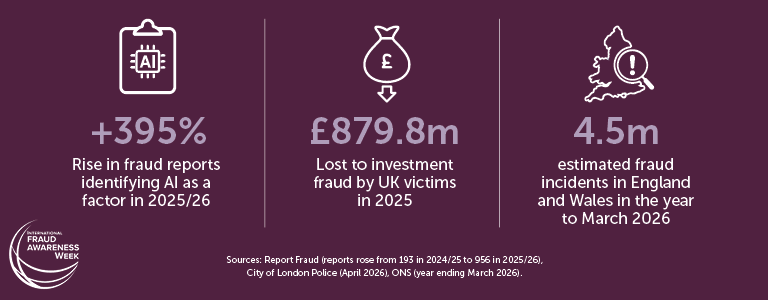
Reports to Report Fraud in which victims identified AI as a factor rose from 193 in 2024/25 to 956 in 2025/26, and associated losses rose from £1.2m to £9.6m (Report Fraud). That’s still a small part of the overall picture, but it’s growing, and investment fraud accounts for the largest share of these reports.
Experian’s 2026 fraud report also warns that fingerprints, facial recognition and voice authentication can all be vulnerable to spoofing and deepfakes.
A convincing voice, video or message isn’t proof that someone is who they say they are. If a request involves money or personal details, check it using contact details you already know and trust.
What are investment scams and how can you spot one?
An investment scam tricks you into putting money into something that doesn’t exist or is worth far less than you are told.
Many investment scams involve authorised push payment (APP) fraud, where criminals persuade you to transfer money directly to them. According to UK Finance, investment scams were the costliest type of APP fraud in 2025, with losses up 40% to £221.5m and cases up 26% to 14,893. Separately, City of London Police reports that victims lost £879.8m to investment fraud in 2025 across all payment types – an average of £1,675 every minute.
Fraudsters use bogus trading platforms, fake bond schemes, cryptocurrency offers and social media adverts that appear to feature well-known public figures. Some copy genuine firms, so the name and website look familiar.
Watch out for:
- Guaranteed returns or rates that are unusually high compared with established providers.
- Unexpected contact by phone, text, email or social media.
- Pressure to act quickly, or to keep the offer confidential.
- A firm you can’t verify independently.
How to protect yourself:
- Check the firm on the FCA Firm Checker and Warning List before you hand over any money.
- Find the firm’s contact details yourself. Use the details on the FCA Firm Checker, not the ones in the offer.
- Take your time. A genuine firm will not mind you checking.
- Consider independent financial advice before you invest.
- Remember that a professional-looking website or glowing testimonial doesn’t make an investment genuine.
- If you’re unsure whether an offer about a Kent Reliance savings product is genuine, talk to our team in branch or call us on 0800 054 6513.
What is SIM swap fraud and how can you avoid it?
SIM swap fraud happens when a criminal persuades your mobile network to move your phone number to a SIM card they control. Once they have your number, they can receive your text messages, including the security codes that banks and other services send to check it is you. This can allow fraudsters to take over your accounts, a crime known as account takeover.
Cifas, the UK’s fraud prevention service, recorded a 402% rise in unauthorised SIM swap cases in the first half of 2026 compared with the first half of 2025. Over the same period, account takeover reports rose 5% to nearly 40,000 cases.
Fraudsters often research their victims on social media and in public records, or pretend to be the mobile provider to gather personal details. They can then use your number to access your bank accounts, make purchases online, apply for credit or reset the passwords on your accounts.
Watch out for:
- Your phone suddenly loses signal or service for no obvious reason.
- Messages from your mobile provider about a SIM or number change you didn’t request.
- Unexpected security codes or being locked out of your accounts.
- Unusual activity on your bank statements, email or social media accounts.
How to protect yourself:
- Ask your mobile provider to add a PIN or password to your account that someone must give before they can issue a new SIM.
- Turn on multi-factor authentication for your email, social media and bank accounts. Where possible, choose passkeys or an authentication app rather than text message codes.
- Limit the personal details you share on social media.
- Check your bank statements and online accounts regularly, and report anything unusual straight away.
- If you lose signal unexpectedly, contact your mobile provider and your bank straight away, using another phone if you can.
- The Met Police has more advice on protecting yourself from SIM swap fraud.
What is courier fraud and how can you avoid it?
Courier fraud is when a fraudster pretends to be a police officer or bank employee and persuades you to hand over money, bank cards or valuables to a courier they send to your door.
National police figures show 1,891 reports of courier fraud between April 2025 and March 2026, an increase on the previous year. Victims lost more than £21m, an average of £15,311 each. Anyone can be targeted, but around 62% of reports involved victims aged between 76 and 96.
Police have seen a growing trend of fraudsters persuading victims to buy expensive jewellery or gold and then hand it to a courier. Offenders also use messaging apps such as WhatsApp and may stay in contact for days or weeks. London and the surrounding regions account for around 65% of victims, and offenders operate across neighbouring counties, including Kent.
Watch out for:
- An unexpected call from someone claiming to be the police or your bank, saying your account is at risk or asking for your help with an investigation.
- Requests to withdraw cash, buy jewellery or gold, or hand over your bank card or PIN.
- Someone arriving at your door to collect these items.
- Pressure to stay on the line, act quickly or keep it secret.
How to protect yourself:
- Your bank or the police will never send a courier to collect cards, cash or valuables, and will never ask you to move money to a ‘safe account’.
- Hang up. Caller ID is not proof of identity. Phone back using a number you trust, such as the one on the back of your card or on your bank’s website, and use a different phone if you can.
- Report suspicious calls by texting the word ‘Call’, followed by the caller’s number, to 7726.
- Consider a call-blocking device, which filters nuisance and scam calls and only lets trusted numbers through.
- Courier fraud can affect anyone, but a large proportion of victims are older adults, so you could talk to older relatives, friends and neighbours about these calls.
Take Five to Stop Fraud
We support the national Take Five campaign. These five steps apply whatever form the scam takes:
1. Never disclose your security details, such as your PIN or full password – even to someone you trust.
2. Don’t assume an email request or caller is genuine – people aren’t always who they say they are.
3. Don’t be rushed – a genuine organisation won’t mind waiting while you stop and think.
4. Listen to your instincts – if something feels wrong, it’s usually right to pause and question it.
5. Stay in control – have the confidence to refuse unusual requests for information.
Are you scam-savvy? Take the Take Five quiz.
“Scams are changing, and behind every figure is a real person. It can happen to anyone, however careful or confident they are. Fraudsters work hard to make a request feel genuine, so if something doesn’t feel right, stop, check and talk to someone you trust.”
Louise Halliwell, Group Savings Director
What should you do if you’ve been scammed?
If you have shared personal information, made a payment or think someone has accessed your account, act quickly.
1. Contact your bank or provider straight away. If you bank with us, call our freephone fraud prevention number on 0800 054 6513 or email customer.security@osb.co.uk.
2. Stop all contact with the fraudster. Don’t send more money or share more information.
3. Secure your accounts. Change any passwords that may be compromised, and contact your mobile provider if you suspect a SIM swap.
4. Report it. Tell Report Fraud online or on 0300 123 2040.
5. Keep a record. Save messages, call details and payment information.
If someone has targeted you, please don’t feel embarrassed. Fraudsters are skilled at manipulating people. Reporting what happened helps you and could protect others too.
How we help you stay safe
Our Fraud Hub has details of the most common scams we see across the industry, along with tools and tips to help you stay alert and informed.
Remember, we’ll never ask you to provide passcodes, ID information or your online login details over the phone, nor will we ask you to move your money to any other account or ask for details regarding any of your other accounts.
Frequently asked questions
What are the most common scams in the UK?
According to UK Finance, purchase scams are the most common type of APP fraud, making up 71% of cases in 2025, while investment scams cost victims the most. Courier fraud and SIM swap fraud can also lead to serious losses, which is why we cover them here.
How do I know if my SIM has been swapped?
Warning signs include losing signal or service for no obvious reason, messages from your mobile provider about a SIM or number change you didn’t request, unexpected security codes and being locked out of your accounts. Contact your mobile provider and your bank straight away, using another phone if you can.
Will my bank ever ask me to move money to a safe account?
No. Your bank or the police will never ask you to move money to a safe account, and will never send a courier to collect your cards, cash or valuables. If you get a call like this, hang up and phone back using a number you trust.
How can I check whether an investment is genuine?
Search for the firm on the FCA Firm Checker and Warning List, and use the contact details it lists rather than those in the offer. Be cautious of guaranteed returns, unexpected contact and pressure to act quickly. Consider independent financial advice before you invest.
What should I do if I’ve been scammed?
Contact your bank or provider straight away, stop all contact with the fraudster, secure your accounts and report the scam to Report Fraud on 0300 123 2040 or at reportfraud.police.uk. If you bank with us, call 0800 054 6513.
Sources
- UK Finance, Annual Fraud Report 2026.
- Cifas, Fraudscape 2026 – 6 Month Update, August 2026.
- City of London Police, Report Fraud Annual Assessment 2025/26.
- City of London Police, investment fraud figures, April 2026.
- Suffolk Constabulary, courier fraud figures, June 2026.
- Experian, UK Fraud, Financial and Identity Crime Report 2026.
Share this article
Related News

Fraud
17 Nov 2025
Three scams to watch out for – and how to beat them

Operations Team
17 Nov 2025
Three scams to watch out for – and how to beat them
Operations Team
Ensuring your savings are safe is at the heart of everything we do. Unfortunately, fraudsters are becoming more sophisticated - using convincing messages, phone calls, and even fake investment opportunities to trick people into handing over their hard-earned money.
Read more
Fraud
18 Nov 2024
Fighting fraud face-to-face
Operations Team
18 Nov 2024
Fighting fraud face-to-face
Operations Team
At Kent Reliance, we do everything we can to ensure your accounts remain secure. But we also recommend staying up to date with the latest scams so that together, we can stay one step ahead of fraudsters.
Read more